
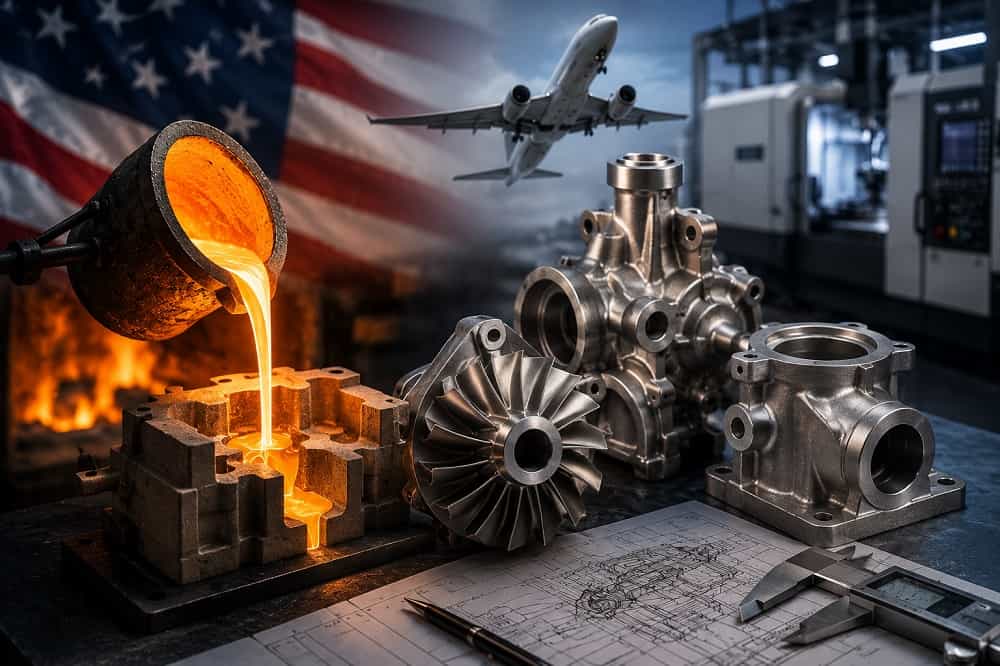
Every manufacturing process has a geometry it owns. CNC machining owns prismatic shapes cut from solid stock. Stamping owns thin sheet formed under press tonnage. Additive manufacturing owns geometries that no subtractive or forming process can produce at all. Investment casting owns something different — it owns complexity that would be prohibitively wasteful, or simply impossible, to produce any other way: internal cooling passages in turbine components, thin-walled housings with integral bosses and ribs, valve bodies with intersecting flow paths machined directly into the as-cast geometry.
That ownership of complexity is why investment casting suppliers USA remain embedded in American OEM supply chains across aerospace, defense, medical devices, oil and gas, and industrial machinery — sectors where the alternative to investment casting is not a cheaper process, but a more expensive one disguised as a simpler one. Understanding the specific economics and capability gap that keeps investment casting essential explains why this 5,000-year-old process — lost-wax casting predates written language — remains current technology in some of the most advanced manufacturing sectors in the United States.
The Buy-To-Fly Problem That Investment Casting Solves
In aerospace manufacturing, buy-to-fly ratio — the ratio of raw material purchased to finished part weight — is a cost metric that drives material selection and process choice as much as mechanical performance does. A titanium structural component machined from forged billet can carry a buy-to-fly ratio of 10:1 to 20:1, meaning 90–95% of an expensive titanium billet becomes machining chips that, while recyclable, recover at a small fraction of the virgin material’s value. An equivalent component produced through investment casting achieves near-net shape with buy-to-fly ratios in the 1.5:1 to 3:1 range — the casting requires only finish machining on critical interfaces, not bulk material removal to reveal the part’s geometry.
For nickel-based superalloys — Inconel 718, Inconel 625, Hastelloy X — used in turbine and energy applications, the same economics apply with even higher stakes, because these alloys cost significantly more per kilogram than titanium and machine considerably slower due to work hardening and tool wear rates that make material removal rates a fraction of those achievable on aluminum or steel. Investment casting suppliers USA producing superalloy components for turbine applications are not competing against machining on a cost-per-hour basis — they are competing on a cost-per-kilogram-of-purchased-material basis, where the casting route’s material efficiency advantage is decisive regardless of the casting’s own process cost.
Wall Thickness, Surface Finish, And the Dimensional Envelope
Modern precision investment casting achieves minimum wall thicknesses of 1.0–1.5 mm in production, with surface finish as-cast running Ra 1.6–3.2 µm — fine enough that many functional surfaces, particularly internal passages inaccessible to machining tools, are used directly in the as-cast condition. Dimensional tolerance capability at the precision end of the industry, per ISO 8062-3 CT4–CT6 grades, holds ±0.10 to ±0.24 mm on a 25 mm nominal dimension — a tolerance band that, combined with the as-cast surface finish, often eliminates the need for secondary machining on non-critical surfaces entirely.
The casting weight range that investment casting suppliers USA serve spans from components weighing a few grams — surgical instrument components, small valve trim — to castings exceeding 100 kg for larger industrial pump and valve bodies, with the process remaining economically viable across that range because the tooling investment, once amortised across production volume, makes the per-part cost competitive with alternatives at almost any production quantity above prototype scale. This breadth of capability across size, alloy, and geometry is what makes investment casting a default specification for complex components rather than a niche process reserved for specific applications.
Additive Manufacturing’s Role — And Its Current Limits
Metal casting manufacturing — powder bed fusion processes producing components layer by layer from CAD data without tooling — has matured significantly and now serves applications where investment casting cannot compete: extremely low production volumes, rapid design iteration during development, and geometries with internal lattice structures or organic topology-optimised shapes that casting tooling cannot replicate. For these applications, additive manufacturing has displaced investment casting in American aerospace and medical device development programs.
For production volumes above roughly 500–1,000 units annually, the economics reverse. Powder bed fusion build rates — typically 5–20 cm³ per hour depending on the machine and alloy — combined with powder costs running 3–8x the cost of equivalent cast alloy in bar or ingot form, and post-processing requirements including hot isostatic pressing and extensive machining to remove support structures and achieve final dimensions, place additive manufacturing’s per-part cost at production volumes well above investment casting’s per-part cost for the same geometry, once casting tooling amortisation is spread across that volume. Investment casting suppliers USA serving production programs above this volume threshold are not competing against additive manufacturing on capability — they are competing on a cost structure that additive manufacturing has not yet closed at production scale, and American OEMs running cost models on both processes consistently find the casting route favourable once volumes clear the tooling amortisation point.
Quality System Requirements: AS9100, NADCAP, And The Special Process Accreditation Layer
American OEMs in aerospace and defense require AS9100D certification as the baseline quality management system standard — an aerospace-specific extension of ISO 9001 that adds requirements for configuration management, risk management, and first article inspection per AS9102. Beyond AS9100D, specific manufacturing processes within investment casting production — heat treatment, non-destructive testing including radiographic and fluorescent penetrant inspection, and welding repair of castings — require NADCAP (National Aerospace and Defense Contractors Accreditation Program) accreditation, an industry-managed accreditation scheme where auditors trained to process-specific checklists assess a supplier’s capability to perform these special processes to aerospace prime contractor requirements.
A foundry supplying investment casting suppliers USA customers in aerospace without NADCAP accreditation on heat treatment cannot supply heat-treated castings for flight-critical applications regardless of its AS9100D certification status, because heat treatment is a special process whose outcome cannot be fully verified by inspection of the finished part alone — the process itself must be accredited. Fluorescent penetrant inspection (FPI) per ASTM E1417, used to detect surface-breaking discontinuities in castings, similarly requires NADCAP accreditation for aerospace supply, with accredited facilities operating under documented procedures covering penetrant type, dwell time, developer application, and inspector certification to ASNT or NAS 410 levels.
Defense Sourcing Requirements and the Specialty Metals Clause
Defense procurement in the United States operates under DFARS (Defense Federal Acquisition Regulation Supplement) requirements that include the Specialty Metals clause — restricting the sourcing of specialty metals, including titanium, certain steel alloys, and superalloys, used in defense end items to melting and production within the United States or qualifying countries under reciprocal defense procurement agreements, with limited exceptions. This requirement directly shapes the supply chain for investment casting suppliers USA producing components for defense end items, because the melting source of the alloy — not just the casting location — falls within the regulatory scope.
For commercial aerospace, industrial, medical, and energy applications outside DFARS-restricted defense end items, American OEMs have considerably more flexibility in qualifying international investment casting sources alongside domestic ones — and the post-2020 emphasis on supply chain diversification has accelerated qualification of international foundries that meet the same AS9100D, ISO 13485 (medical devices), or API (oil and gas) standards that domestic suppliers operate under. Siddhalaxmi, an investment casting manufacturer based in Pune, India, operating since 1967 with production capacity of 2,000 metric tonnes annually across more than one hundred alloy grades and a customer base spanning over fifty countries, represents the category of international foundry that American OEMs in non-DFARS-restricted sectors have increasingly qualified as approved sources — bringing the same dimensional, material, and documentation standards that domestic supply chains require, sourced from a production base with cost structure advantages that domestic-only sourcing cannot match.
Why The Reliance Persists Despite Decades of Alternative Process Development
The persistence of investment casting in American OEM supply chains is not inertia. Every major alternative process — CNC machining from billet, additive manufacturing, die casting, sand casting — has been evaluated against investment casting repeatedly over decades by OEM manufacturing engineering teams running real cost models against real components. Investment casting has not survived these evaluations by default. It has survived because for the specific combination of geometric complexity, alloy requirement, production volume, and dimensional tolerance that characterises a large share of components in aerospace, defense, medical, and energy applications, no alternative process produces a lower total cost at equivalent quality.
Investment casting suppliers USA rely on, whether domestic or international, are suppliers that have continued investing in the specific capabilities — tighter tolerance grades, broader alloy ranges, NADCAP-accredited special processes, AS9100D and equivalent quality systems — that keep the process competitive as OEM requirements have become more demanding rather than less. The process is old. The supply base serving it is not standing still.
Conclusion
American OEMs rely on investment casting suppliers USA because the alternatives, evaluated honestly against real cost models, do not displace investment casting for the geometries, alloys, and volumes that define a large portion of complex metal component demand in aerospace, defense, medical, and industrial sectors. The reliance is not nostalgic. It is the output of buy-to-fly economics on expensive alloys, dimensional and surface finish capability that reduces or eliminates secondary machining, and a quality system infrastructure — AS9100D, NADCAP, ISO 13485 — that the supply base has built and maintained specifically because OEM requirements demanded it.
That reliance increasingly extends to a global qualified supply base, not a purely domestic one, for the sectors where sourcing flexibility exists — and the foundries earning that qualification, wherever they are located, are the ones that have matched the tolerance, material, and documentation standards that American OEM manufacturing engineering teams have spent decades refining.