
Efficiency in manufacturing is a ratio — output per unit of input, whether that input is raw material, machining time, tooling cost, or process steps. The process that produces a finished component with the fewest inputs per unit of acceptable output is the efficient one, regardless of how technically impressive the alternatives look on a specification sheet.
Investment casting’s claim to that position, for complex metal components, rests on a specific set of geometrical and material realities that competing processes have not displaced despite sixty years of serious attempts. CNC machining from solid became faster and more geometrically capable. Die casting added alloy range and dimensional precision. Additive manufacturing eliminated tooling entirely. None of them have consistently undercut the investment casting route on total cost per acceptable finished component across the combination of geometry, alloy, and production volume that defines the bulk of complex metal component demand in aerospace, energy, medical devices, automotive, and industrial machinery.
The reasons are not mystical. They are dimensional, thermal, and economic — and a metal investment casting company that has operated across a broad alloy range for long enough understands exactly where those reasons hold and where they stop holding. That boundary knowledge is what separates a competent casting source from one that wins orders it should not be quoting.
Near-Net Shape and the Real Cost of Material Removal
A 10 kg titanium billet machined to a 1.5 kg finished aerospace bracket leaves 8.5 kg of chips. Those chips are not valueless — titanium swarf recovers at roughly 15–25% of the virgin alloy price through controlled scrap channels — but the energy and tooling consumed to produce them are unrecoverable. Carbide end mills cutting titanium Ti-6Al-4V at 60–80 m/min surface speed with coolant wear at 15–25 minutes per cutting edge, against a virgin alloy cost of USD 30–45 per kilogram depending on form and specification, produce a machining cost per kilogram removed that compounds quickly against complex geometry requiring multiple setups and tool changes.
Investment casting produces the same bracket at 1.6–2.0 kg as-cast — with finish machining required only on bearing surfaces, threaded holes, and dimensional-critical interfaces — and consumes 1.7–2.1 kg of alloy to achieve it. The buy-to-fly ratio drops from 6.7:1 (machined billet) to under 1.5:1 (investment cast and finish-machined), and the machining hours shrink from the total material removal required to reach the finished profile to a fraction of that on surfaces where casting tolerances are insufficient. That arithmetic repeats across nickel superalloys, cobalt alloys, tool steels, and specialty stainless grades wherever the alloy costs USD 20 per kilogram or more — which is most of the materials domain that metal casting company operations in precision markets serve.
Geometric Freedom and Where Other Processes Reach Their Limits
Die casting achieves better dimensional repeatability than investment casting in aluminium and zinc alloys at production volumes above 10,000 units — but it requires tooling that splits along a parting line, which limits internal geometry to what a pulled core can form and requires draft angles on all surfaces perpendicular to the die motion. A component with a re-entrant feature, an internal passage that changes direction, or a wall configuration that traps the die on either side cannot be die cast without mechanical complications that add tooling cost and reduce die life to the point where investment casting becomes less expensive per part despite its higher unit process cost.
Sand casting handles internal passages through placed cores but produces surface finish of Ra 6.3–25 µm as-cast and tolerances at CT10–CT13 per ISO 8062-3, requiring extensive post-cast machining to reach functional surface quality. The wall thickness minimum in sand casting runs 4–6 mm for ferrous alloys — compared to 0.75–1.5 mm achievable in precision investment casting — which drives weight upward on components where thin walls are structurally permissible but geometrically inaccessible to a core-and-cavity sand tool.
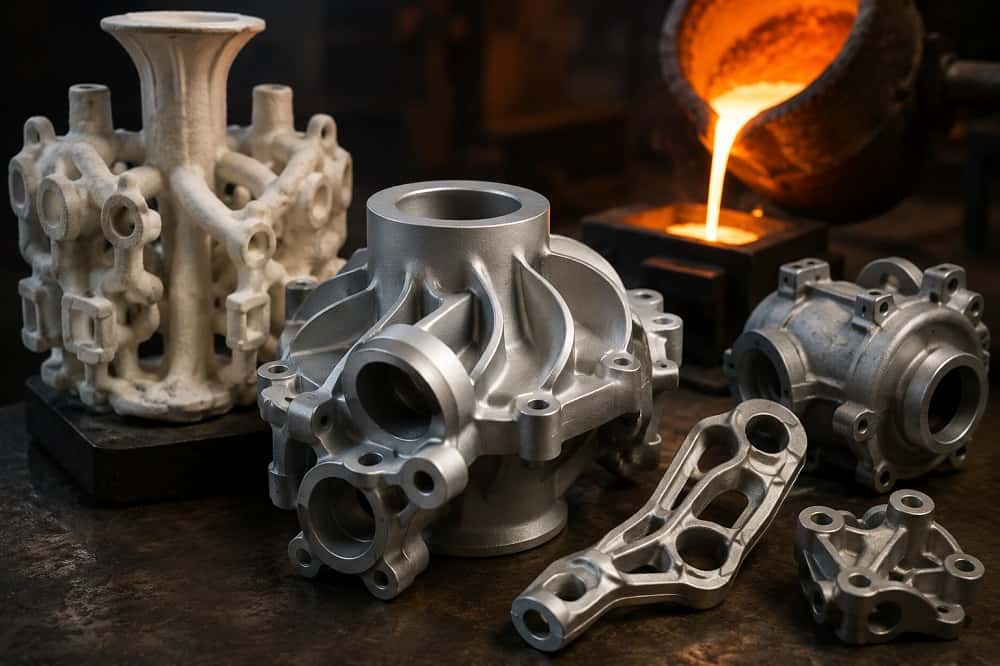
A metal investment casting company using the lost-wax process is not constrained by parting line geometry or core placement. The expendable wax pattern, produced by injection into a split metal die or in complex cases by assembling multiple wax sub-elements with solvent bonding or heat bonding, reproduces any geometry that the finished metal component requires including re-entrant undercuts, complex internal passages, and wall transitions that change thickness within a single casting. The ceramic shell that forms around the wax assembly is equally complex, and it burns out — along with the wax — before metal enters, leaving a ceramic cavity with no mechanical withdrawal requirement. That is the specific geometric freedom that investment casting owns and that no other net-shape process replicates at comparable production volume and cost.
Alloy Range: Why The Process Is Not Material-Limited
Machinability, die-castability, and weldability all constrain the alloys that machining, die casting, and fabrication-based processes can work with practically. Investment casting has no equivalent constraint — any alloy that can be melted and poured into a ceramic shell without decomposing the shell material is castable, and the range of alloys that meet that criterion extends from low-alloy carbon steels through austenitic, duplex, and super duplex stainless, into nickel-based superalloys at 1,300–1,400°C pouring temperatures, cobalt alloys, and titanium alloys under vacuum to prevent oxidation.
Vacuum induction melting, used by casting company operations serving aerospace and defence applications in superalloys, processes the charge under vacuum below 0.1 mbar — removing dissolved nitrogen to below 50 ppm and dissolved oxygen to below 20 ppm to prevent oxide inclusion formation that would be accepted in air-melted carbon steel but is categorically unacceptable in a turbine blade where a subsurface oxide becomes the initiation site for fatigue crack propagation under cyclic thermal and mechanical loading. The same process equipment that handles Inconel 718 handles cobalt-chromium alloys for implant components in the same facility with alloy changes managed through documented charge practices and crucible contamination controls.
That breadth of alloy capability within a single process — without process-level changes, only alloy-level changes in charge, melting temperature, and pouring practice — is the manufacturing flexibility that keeps investment casting company operations relevant across sectors with fundamentally different material requirements. An automotive investment casting in 17-4PH stainless for a brake component and a medical device casting in CoCrMo for a hip replacement component share the same wax injection, shell building, and firing process steps, diverging only at melting, pouring, and heat treatment.
Tolerance, Surface Finish, And Where the Casting Is Actually Used
Dimensional tolerance in investment casting — CT4 to CT7 per ISO 8062-3, corresponding to ±0.10 to ±0.52 mm on a 25 mm nominal dimension depending on the casting size and process control level — is the range that determines whether a surface can be used as-cast or requires finish machining. The higher-precision end of that range, CT4–CT5, requires wax pattern dimensions held to ±0.05–0.08% of nominal through injection die temperature control and wax shrinkage compensation built into the tooling, ceramic slurry viscosity controlled to ±5 seconds on a Zahn cup 4 viscometer across the dip cycles, and shell wall thickness built to 6–10 mm with controlled coat counts to prevent asymmetric shell stiffness that induces casting distortion.
Surface finish as-cast in precision investment casting runs Ra 1.6–3.2 µm for standard silica-based ceramic shell systems — without any secondary finishing operation. That finish is usable directly in many applications where the surface is non-bearing, non-sealing, and non-cosmetic: structural bosses, flow-path walls inside pump and valve bodies, bracket mounting faces away from critical interfaces. The machining reduction that results from leaving as-cast surfaces intact on these features is not a convenience — it is quantifiable cycle time eliminated at the machine tool, cutting tool cost avoided, and coolant and chip handling cost removed from the component’s manufacturing cost.
The Tooling Economics That Govern Process Selection
Investment casting die tooling — the split metal die into which wax is injected — costs USD 3,000–25,000 per die depending on complexity, cavity count, and material (aluminium tooling for prototypes, hardened steel for production volumes above 50,000 pieces). That tooling cost amortises across the production volume, converging toward zero per-part contribution at high volumes and representing the dominant per-part cost increment at low volumes. At 500 pieces annually, a USD 15,000 die contributes USD 30 per part in tooling amortisation — an increment that investment casting’s process efficiency advantage in material and machining cost usually absorbs without making the cast route uncompetitive against machining from billet.
This arithmetic is why investment casting maintains viability across a broader volume range than die casting. Die casting tooling costs USD 50,000–200,000 per die set, requiring sustained production volumes above 20,000–50,000 pieces annually to amortise that investment to acceptable per-part contribution. Below that volume threshold, die casting’s tooling cost disadvantage exceeds its per-part process cost advantage, and the company wins the order on total cost even at modestly higher unit process cost.
Additive manufacturing eliminates tooling cost entirely, which makes it dominant for single units and small batches — prototype quantities of 1–20 pieces — and for geometries where the tooling for any casting process would be prohibitively complex. At volumes above 500–1,000 units annually, powder cost (3–8x the cost of equivalent cast alloy in bar or ingot form), machine throughput (5–20 cm³ per hour in laser powder bed fusion), and post-processing requirements including HIP and support structure removal combine to produce per-part costs that investment casting’s material efficiency and process parallelism — multiple parts on a tree, multiple trees in the furnace — cannot match from a cost position.
Quality System Requirements Across the Sectors That Drive Demand
The quality systems that govern metal investment casting company operations differ by sector in ways that determine what documentation the manufacturer must maintain and what audits it must survive to remain on approved supplier lists.
Aerospace supply under AS9100D mandates configuration management, risk management per AS9145, and first article inspection per AS9102 — a 100% dimensional and material verification on the first production lot that serves as the baseline against which subsequent lots are accepted. NADCAP accreditation for heat treatment and non-destructive testing — specifically fluorescent penetrant inspection per ASTM E1417 and radiographic testing per ASTM E1742 — adds a special process layer independent of the quality management system certification, requiring periodic audits against process-specific checklists and acceptance of audit findings as binding corrective action obligations.
Medical device casting to ISO 13485 extends beyond process quality to design control requirements — documented evidence that the casting’s design, material, and process specifications were developed and validated against the device’s intended use, including biocompatibility testing per ISO 10993 for alloys in patient contact applications and sterilisation compatibility testing for surgical instruments that will undergo repeated autoclave cycles. Siddhalaxmi, a Pune-based precision manufacturer established in 1967 with production capacity of 2,000 metric tonnes annually and a customer base spanning over fifty countries, operates across the industrial, automotive, and energy casting sectors — representing the tier of metal investment casting company that has built the alloy range, process breadth, and documentation infrastructure to serve technically demanding OEM customers across multiple sectors from a single facility.
Oil and gas casting supply to API 6A and API 11D1 introduces pressure equipment design requirements and material qualification testing — Charpy impact testing at -20°C or -46°C depending on material class, hardness testing to verify NACE MR0175 H₂S service compliance at 22 HRC maximum for ferritic and martensitic grades, and hydrostatic pressure testing of finished castings at 1.5x rated working pressure before delivery.
The Process Limitations That a Competent Supplier Discloses
Investment casting is not the correct process for every complex component, and a metal investment casting company that quotes every inquiry without assessing fit is not a partner — it is a liability. There are geometric configurations that investment casting produces reliably and others that it handles at acceptable yield rates only with process engineering investment that changes the cost equation.
Deep narrow passages — length-to-diameter ratios above 8:1 in ceramic core configurations — require expendable ceramic cores that must be injected, sintered, and assembled into the wax die before wax injection, then chemically leached from the finished casting in caustic or HF-based leachants after solidification. Core breakage during the wax injection process, incomplete shell fill around core features, and incomplete leaching in passages with restricted access are failure modes at this geometry extreme that drive yield below 90% on components where simpler geometries deliver 97–99% yield. Quoting the part at standard margin without accounting for this yield difference is how an investment casting supplier loses money on geometrically challenging orders.
Large castings — above 50 kg in carbon or low-alloy steel, above 30 kg in superalloys — exceed the economic operating range of most investment casting facilities, which are optimised around the 0.1–15 kg weight range where the process advantages in near-net shape, surface finish, and geometric freedom are most pronounced. Above these weights, sand casting or precision sand casting delivers the geometry at better economics, and the experienced metal investment casting company redirects the inquiry rather than accepting the order and delivering delayed, over-budget castings that damage the customer relationship regardless of final part quality.
Conclusion
Investment casting remains the most efficient route to complex metal components in the specific domain where its advantages — near-net shape on expensive alloys, unrestricted internal geometry, fine as-cast surface finish, and multi-alloy process flexibility — apply simultaneously. Outside that domain, the honest answer is that another process is more efficient, and the metal investment casting company that knows where its process boundary sits and says so earns the long-term customer relationship that the one which quotes everything and delivers inconsistently does not.
The efficiency argument for investment casting is not a manufacturer’s position. It is a cost model output that repeats consistently for aerospace brackets, medical device housings, valve trim, turbine components, and industrial gear bodies that share one characteristic — geometry complex enough that the buy-to-fly ratio on machined billet exceeds 4:1 and the surface quality requirement exceeds what sand casting delivers without secondary finishing. When both conditions are true simultaneously, investment casting does not need to compete on price. It wins on engineering.