
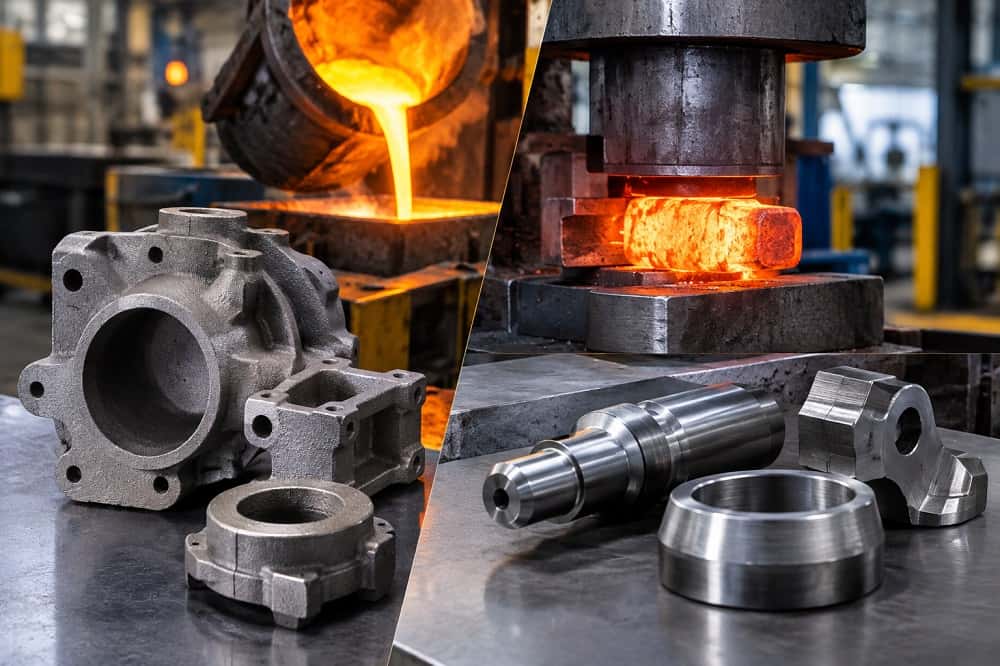
Tool steels possess characteristics enabling them to withstand repeated physical stresses, such as friction and load, as well as temperatures. Unlike mild or alloy steels, tool steels are engineered with elements to increase their toughness, wear resistance and heat resistance. This makes them ideal for use in components which must remain durable under repeated production cycles.
Tool steel casting is a valuable method to form parts from these materials. The process enables the creation of near-net-shape castings, minimising the need for extensive post-process machining. It allows complex and difficult forms to be created from wrought material. Depending on the desired outcome, cast tool steel forms can be applied to a broad range of industrial tooling and components.
Factors Determining Tool Steel Castings’ Suitability
The performance of a tool steel castings depends considerably on its chemical formulation and heat treatment. Common alloying elements include chromium, molybdenum, vanadium, and tungsten; and these can enhance the metal’s ability to resist abrasion and retain its structural integrity under extreme conditions. Carbon content also has a strong impact on a tool steel’s capacity to resist wear and tear. Elements such as these when included in the alloying process create a steel better suited to its intended function in industrial applications.
As a general rule, tool steels are used in applications where the metal will be subjected to consistent and extreme forces. Tools, dies, and machinery will naturally endure pressure as they work, sometimes under extreme heating. The correct tool steel, however, can be selected to endure these forces, without sustaining damage or requiring expensive maintenance.
Tool steel casting offers further advantages for such applications. It is possible to create tooling elements with intricate cavities or difficult geometries which are not easily machined. Moreover, casting entails less wastage than wrought material production processes. A casting will entail less material machining, therefore producing less metal dust and requiring less time to finish.
Automotive Industry Applications
The automotive industry comprises a wide range of vehicles, equipment, and tooling. This extends from the manufacturing and stamping equipment to the machinery and wear parts used in component production. Each part of the process presents different material requirements, with the tooling and stamping components often encountering the most extreme production conditions. Tool steel is widely used in the manufacturing and production side of automotive equipment.
Tool steel casting produces the various parts and tooling associated with metal forming and production, such as holders, moulds, and supports. In each application, the material’s resistance to pressure, abrasion, and surface degradation makes it a near-indispensable choice in many automotive casting part manufacturing processes. Stamping tooling dies, for instance, typically require an extremely durable material with wear-resistant qualities to maintain their shape and specification throughout the high-speed production process.
Tooling production equipment for stamping purposes involves some of the highest pressures in the industry. Moreover, many automotive tooling equipment, as mentioned, entails the highest production output, where even a minor delay or malfunction can lead to substantial losses. As such, ensuring that the tooling is of the highest quality with the longest production lifespan is frequently of particular concern to manufacturers.
Applications in General Engineering
Engineering covers a wide variety of fields, materials, and equipment. The engineering industry works with a broad variety of tools, machinery, and production equipment. In these applications, tool steel benefits engineers by providing a selection of metal grades which can resist varying combinations of physical stresses. The process of casting tool steels is also of great benefit in these applications.
This is especially so in cases where complex tooling and machinery equipment is needed. Dies, punches, and guides are among the types of tooling equipment which are created through tool steel casting. Similarly, machinery parts and components such as forming tools and wear parts are also made from cast tool steels and used in various engineering applications.
In some forming tools applications, the tool must meet two mutually-exclusive sets of requirements. Under repeated pressure, it is necessary that the metal be sufficiently hard and tough enough to endure the force without cracking and the surface being abraded. This requires that the process engineer take this factor into account to ensure that material properties are not compromised in one area to enhance the other.
Tool Steel Casting Applications in Manufacturing and Production
The manufacturing process entails a wide variety of tools and equipment used to form, cut, and fabricate a component. Tooling and wear parts are applied to almost all aspects of the production cycle across a variety of industries. The manufacturing process has particularly strict requirements for tooling because of its repetitive and often extreme processes. Unlike in general engineering, tooling and dies that encounter such forces will rapidly degrade and/or require costly and time-consuming replacements without the correct tooling materials.
Industrial manufacturing and production processes involve cutting, forming, stamping, compressing, and moulding. Tool steels are resistant to abrasion and wear and can sustain significant pressure. Some tool steel grades are also more heat-resistant, with their characteristics being unaffected by extreme temperatures. This is a vital characteristic for manufacturing, and certain tool steels are better than others at withstanding it.
A further advantage of tool steel casting for manufacturing purposes is its ability to produce complex or custom shapes. Tooling can be designed with the specific machine, process, or even component in mind rather than being of standard shape or size.
Key Factors in Tool Steel Casting
The process of casting, in addition to the chosen grade of steel, affects the resulting quality of the produced component.
Factors such as:
- Steel grade and alloy must fit the expected loading, wear, impact and thermal conditions.
- Mould, poured ingots and subsequent solidification affect the integrity of the final product.
- Heat treatment is required to obtain the necessary characteristics.
- Dimensional inspection and other forms of testing can be employed to detect imperfections.
Tool steel components, when improperly controlled through any stage, can exhibit shortened service life. Especially for demanding applications, the process selection and control can be as important as the steel grade.
The Impact of Heat Treatment
The process of heat treatment can have a significant effect on the performance of the tool steel casting. Depending on the steel grade, treatments such as hardening, tempering, annealing, and stress-relieving can be applied. The treatments alter the microscopic structure of the metal, affecting its hardness, which impacts its wear resistance, with greater hardness offering greater protection against loss of material. Hardness, however, also negatively affects the material’s ability to resist impact and deformation, which must be taken into consideration when choosing the treatment.
Casting and Final Machining
While the casting process can produce parts that are very close to the final shape, additional machining is often required to finish the part. Tool steel, when hardened, can be particularly challenging to machine. The choice of the machining process and the necessary allowances when casting must be taken into consideration. In addition to allowances, the machining process, capability, and centre must be able to accommodate the complexity of the required shape and any additional finishing operations.
For many tools, the dimensional tolerances of the machined surfaces are critical, and their conformity must be checked after machining is completed. The deviation, even on a microscopic scale, can affect the operation and performance of the final tool.
Siddhalaxmi’s Approach to Industrial Casting
Siddhalaxmi is a foundry company that can supply casted components that require the controlled application of material, including the selection of the steel grade. On their website, they list their capabilities and potential applications for their services.
Approach to Casting Tool Steel Components
The decision to use a casted part made from tool steel over other options depends on the required geometry and the capabilities of the manufacturing process. When the part’s complexity or size would result in excessive machining requirements or waste, the casting process can be preferable. Engineers should also consider the anticipated service conditions when selecting the material and the manufacturing process. Impact, abrasion, temperature, corrosion, and maintenance capabilities are some of the factors that must be considered when selecting a steel grade and a production method.
Conclusion
Tool steel enables the production of components that are exposed to substantial mechanical and thermal loads. In many cases, the combination of the material’s hardness and toughness makes it the favoured choice over other materials. A variety of tools and dies require its application, from automotive stamping tools to engineering dies, and parts subjected to abrasive forces in industrial machinery.
Tool steel casting can enable the production of complex shapes with tighter dimensional tolerances than would otherwise be possible. When the steel grade, the manufacturing process, heat treatment, and any additional operations are properly selected and controlled, the tool steel component can exhibit favourable characteristics and longevity. For industrial manufacturers, the benefits of reduced downtime and longer equipment life can be substantial.