
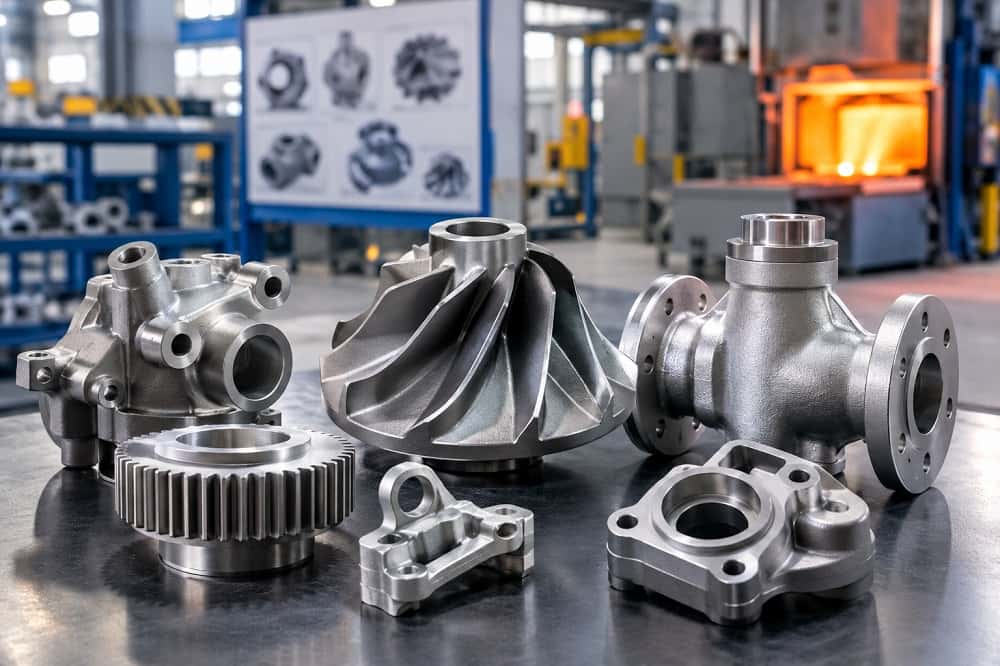
In the great machinery of global industry, one unseen process keeps the gears of progress turning: investment casting. It never hits the news, but this centuries-old process, perfected with twenty-first century technology, is the secret to the dependability of jet engines, the safety of medical implants, and even the quality of the automobiles that drive on every highway. What makes this process leap from ancient craft to industrial backbone is more than metallurgy or tooling; it is the precision investment casting suppliers choice. Make the wrong choice, and efficiency falters. Make the right choice, and performance is raised across the board.
What distinguishes industries that are racing ahead from those that are hampered by inefficiency is not necessarily design innovation but the unshakeable dependability of the partners they select. That choice—selecting the proper manufacturing partner—dictates the quality of parts that, literally, hold together modern infrastructure, energy networks, aerospace equipment, and surgical instruments.
Why Precision Matters More Than Ever
Industrial history is an account of diminishing tolerances. Where “close enough” was good enough in the past, now a slightest deviation could jeopardize a billion-dollar engine project or risk lives in an operating room. Factories that were previously fixated on productivity are now fixated on predictability. Each component is a test of loyalty to design.
Investment casting addresses this pressure point. It creates intricate geometries without costly secondary machining. It weighs performance against weight. And it enables engineers to produce forms other processes cannot achieve. Selecting the appropriate precision investment casting manufacturer means not just receiving precise parts but finding someone who can deliver flawlessness on a large scale, thousands of precise components that meet strict specifications.
The Evolution from Art to Science
Casting for investment started in the studios of craftsmen modeling wax for decorative metals, but modern casting is hardly recognizable from its beginning. Computer models are realized in wax patterns cut by robots or 3D printing. Ceramic shells are constructed layer upon layer with scientific accuracy. Alloys are designed for toughness, fatigue life, and corrosion resistance. Each furnace pour is directed by automation with the help of data logging, and each step is compared with quality certifications required internationally.
The change has been one from art to science—and it is science that new industries cannot do without. Aerospace turbine blades, defense parts, intricate automotive turbochargers, precision valves for oil and gas—each is indebted to this advancement in terms of practicality and performance.
Within the Casting Process
Though the principles are simple, the application is ruthless. Precision entails consistency at each step:
- Wax injection into dies or 3D-printed patterns for dimensional accuracy.
- Sprue tree assembly, increasing efficiency and consistency.
- Layered ceramic shell construction, a ballet of slurry coats and drying cycles.
- Burnout in precisely controlled kilns to remove wax residues without compromising shell strength.
- Pouring molten alloys into preheated molds at precisely calculated temperatures.
- Shattering away shells, followed by heat treating, machining, and polishing to strict technical specifications.
To the outsiders, it might appear to be a series of pours and coatings. But insiders realize each and every step is an opening for mistake—and the manufacturer’s skill is what creates the difference between industrial performance or industrial failure.
The Business Case for Industrial Performance
Choosing a good casting partner affects not only engineering, but also operating expenses, lead time, and innovation capability. Procurement managers, calculating total cost of ownership—not merely unit price—find that a reliable precision investment casting manufacturer saves money in several areas:
- Less machining and finishing saves man-hours.
- Lower rejection rates protect delivery schedules.
- Batches that work consistently improve supply chain dependability.
- Material expertise access enables smarter alloy choices.
- Partnering on design-for-casting maximizes performance at the design level.
This is why top companies approach casting partnerships as strategic assets, not transactional procurements.
Where Performance Is Won: Core Industries
The significance of precision casting is gauged by the extent of its application in industries where no compromise can be accepted:
Aerospace
Turbine blades, housings and structural components are subjected to extreme thermal and mechanical stress. Dimensional deviation is not acceptable as it affects flight safety and fuel efficiency. Castings here must be perfect and that means manufacturers with deep aerospace knowledge.
Automotive
With electrification pushing the boundaries of lightweighting and efficiency, parts like turbocharger housings, gearbox components and safety critical brackets rely on castings that combine strength with thin wall complexity. High volume consistency makes or breaks automotive partnerships.
Oil & Gas
Pressurized valves, pumps and impellers for corrosive and high temperature environments require alloys and casting expertise to withstand brutal operational realities. Unreliable parts mean catastrophic financial, environmental and human consequences.
Medical
Orthopedic devices, surgical instruments, and diagnostic equipment all need to be cast with tight tolerances in biocompatible alloys. Accuracy is necessary for safety in patients. Producers here ship to some of the toughest standards of all.
Industrial Machinery
From heavy mining equipment to power generation turbines, investment castings minimize weight, enhance strength, and withstand high mechanical loads. They form the backbone of worldwide heavy industry’s productivity.
The Difference Between Manufacturers
Not every supplier is on the same level. “Investment casting house” does not necessarily imply “precision.” Some have older equipment, manual variation, or restricted alloy capacity. The proper decision is one in which quality systems, sophisticated design capability, metallurgy talent, and solid testing facilities all meet. That distinction directly translates into industrial performance.
- Industry certifications indicate compliance with worldwide quality systems.
- In-plant metallurgical facilities speed up testing and ensure alloy chemistry.
- Nondestructive testing confirms concealed defects are discovered prior to release.
- ERP-based work processes integrate planning, production, and delivery into streamlined systems.
The question is no longer “can a part be cast” but “can it be cast accurately, reliably, and economically.” Only a select few partners answer that with certainty.
Why the Manufacturer Becomes a Strategic Partner
In increasingly volatile global supply chains, industrial leaders now view reliable casting partners as more than vendors; they see them as strategic partners. An efficient precision investment casting supplier can accelerate product development cycles by providing engineering feedback in the design phase. This co-engineering approach avoids expensive revisions later on.
In addition, companies possessing worldwide logistics capabilities, vendor-managed inventory systems, and long-term supply commitments become supply-chain enablers. They do not just provide parts but provide stability, something in unstable markets as valuable as technical quality.
Technology and Innovation Driving the Future
The business is already being disrupted by changes that underpin the value of the selection of the right partner:
- Additive Manufacturing Integration: Direct-to-file digital-to-wax printing accelerates prototyping and lowers tooling expenditure.
- AI-Driven Process Monitoring: AI is used by intelligent foundries to track shell drying cycles, furnace heat, and metal flow dynamics.
- Sustainable Casting: Energy-efficient furnaces, recyclable shell materials, and waste-minimization processes are compatible with the latest ESG standards.
- Advanced Metallurgy: The development of superalloys for high temperatures, the evolution of duplex stainless steel, and the production of titanium-based alloys are some of the ways that have extended the application field.
The right manufacturer means companies get to harness these technologies first not play catch up.
Gauging the Impact in Real Terms
The advantages of having an innovative casting supplier extend across performance metrics:
- Cycle Time Reduction: Production to prototyping schedules dwindle.
- Inventory Stability: Consistent deliveries minimize buffer stock requirements.
- Operational Reliability: Parts meet design specifications, reducing downtime.
- Innovation Cycles: Accelerated prototyping enables quicker entry of new products to market.
These are not intangible benefits—they determine competitiveness in highly competitive global industries.
Choosing the Right Partner
When industries choose casting suppliers, a checklist of characteristics surfaces as non-negotiable:
- Comprehensive track record in key sectors.
- High-level material and engineering capabilities.
- Sophisticated quality control ecosystems, such as destructive and nondestructive testing.
- Sector-relevant certifications.
- Transparent communication during design, production and delivery.
- Long term strategic alignment and sustainability
Finding all of these in one supplier is rare – and industries know once you find them, it’s a performance transformation for decades.
A Local Gem with Global Performance: Siddhalaxmi
One example of this caliber—deeply rooted, yet globally capable—is Siddhalaxmi. Established over 55 years ago in Pune, this engineering technocrats’ firm blends zero-debt stewardship, material science expertise, digital quality tools, machining integration, ESG focus, and capacity for 180 tonnes per month. With such a foundation, the company exemplifies how the right partner delivers industrial performance with precision, reliability, and sustainability.
Conclusion: Raising Industry with the Right Decision
Industrial leadership is founded upon unseen components: a turbine blade, an oilfield valve, an implant in a patient’s body. They are here only because somewhere a producer solved the complicated alchemy of wax, ceramic, and molten metal, doing it the same way, over and over.
Selecting the appropriate precision investment casting manufacturer is thus not a line item on the procurement budget—it is the lever that raises industrial performance overall. Each effective aircraft engine, each dependable surgical instrument, each secure valve in a pressured system attests to that choice.